Exercise Library

Seated Cable Row

A seated rowing exercise using a low cable pulley, bench and foot supports. It trains the back and elbow flexors, with grip and elbow path influencing the movement and muscular demands.
PRIMARY MUSCLE
Latissimus dorsi
SECONDARY MUSCLES
Teres major · Middle trapezius · Rhomboids · Posterior deltoids · Biceps brachii · Brachialis · Brachioradialis
MUSCLES INVOLVED
Exercise Demonstration Watch the Movement
Technique

How to Perform

Follow the setup and execution sequence below before adding load or increasing training intensity.

01

Setup

Select a manageable resistance with the weight stack resting. Attach the close neutral-grip handle and check that the connector is fully closed.
Sit on the bench and place both feet securely against the foot supports. Keep the knees slightly bent.
Take the handle and establish an upright torso with a comfortable spinal position. Position yourself so the arms can straighten without the cable reaching its travel limit or requiring excessive forward leaning. Brace gently before starting.
  • Selector pin fully inserted.
  • Attachment securely connected.
  • Feet firmly against the supports.
  • Knees slightly bent.
  • Comfortable reach to the handle.
  • Torso upright and controlled.
Equipment & Machine Setup

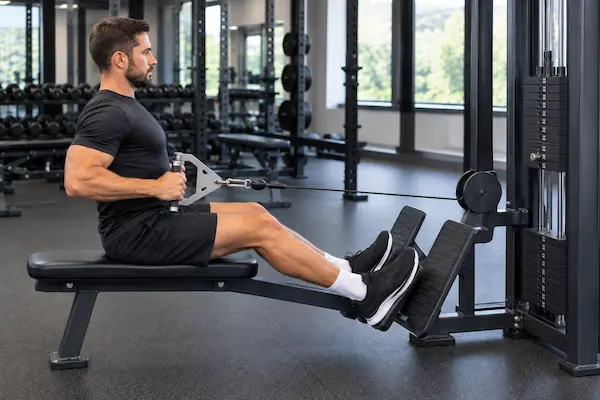
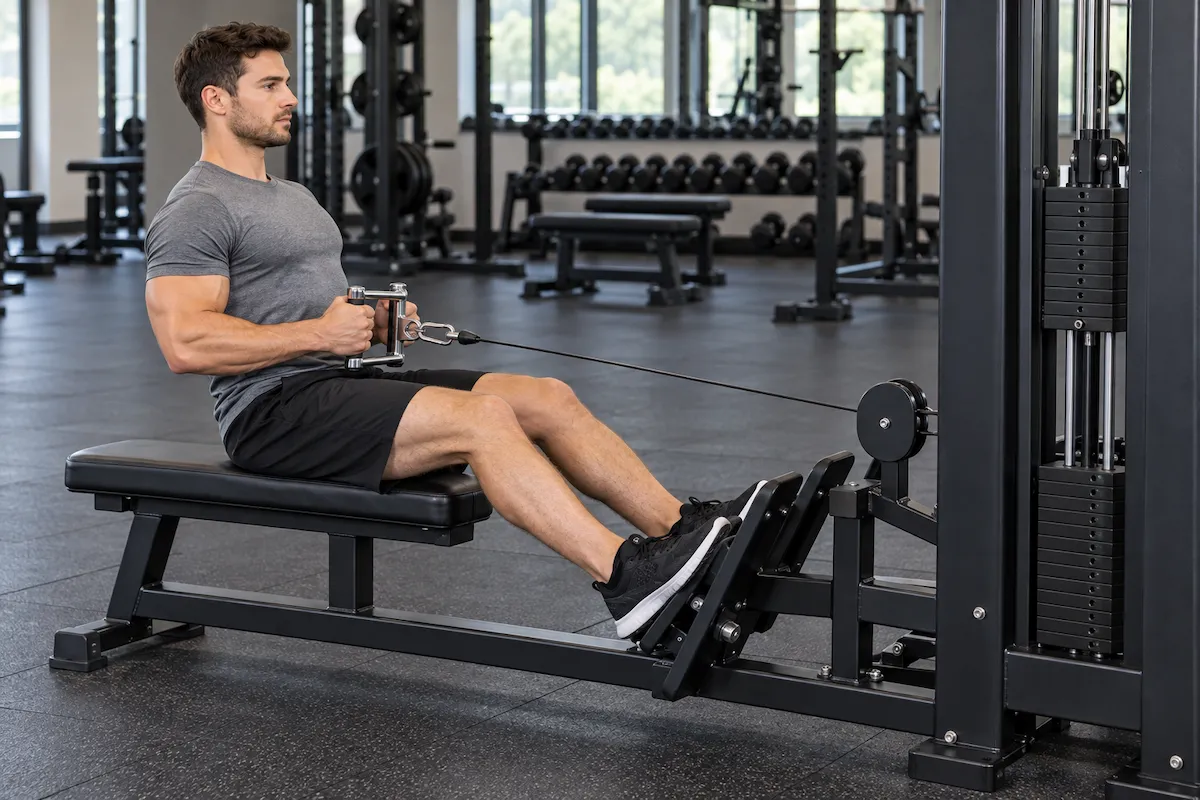
Use the station’s dedicated bench, foot supports and low cable outlet. This version uses a close neutral-grip attachment, with the palms facing each other. Adjust your seated position to accommodate the attachment’s length and available cable travel. Test the range with light resistance before working sets. Change the selector pin or attachment only when the stack is resting. Record the selected load and attachment when tracking progression. Other seated grip options are described in Equipment & Grip Options.
02

Execution

Pull the handle towards the upper abdomen, guiding the elbows backwards close to the torso. Allow the shoulder blades to move towards each other while maintaining a steady trunk.
Finish the pull where you can retain control without leaning backwards, shrugging or forcing the shoulders forwards. The handle does not need to touch the body.
Return smoothly, allowing the elbows to straighten and the shoulder blades to move forwards. Keep the torso controlled rather than rounding the lower back to extend the reach.
Repeat through a consistent, comfortable range. After the final repetition, guide the weight stack gently to rest before releasing the handle.
  • Guide the elbows backwards near the torso.
  • Pull towards the upper abdomen.
  • Allow natural shoulder-blade movement.
  • Keep the trunk steady.
  • Avoid forcing the finishing position.
  • Control the return.
  • Lower the stack gently.

Equipment & Grip Options

Attachments change hand position and the elbow path you can use. A tucked-elbow row involves more shoulder extension and relatively more lat activity; a more open-elbow row increases shoulder horizontal abduction and relative posterior-deltoid and trapezius activity. Choose the grip and path together, based on comfort, range and machine clearance.

Close neutral-grip cable row attachment with two parallel black hand grips and a metal connection eye.

Close Neutral-Grip Row Handle

A two-hand row attachment with closely spaced parallel grips.

Read more Show less about Close Neutral-Grip Row Handle
Grip
Neutral — palms facing each other.
Hand spacing
Close.
Arm action
Simultaneous two-arm rowing.

What Changes

The close neutral grip supports a tucked-elbow path, with shoulder extension as the main shoulder action. In a seated-row EMG study, closer elbow paths showed higher lat activity than more abducted paths. The handle does not isolate the lats or guarantee greater muscle growth.

Elbow & Pulling Path

Guide the elbows backwards near the torso and pull towards the upper abdomen.

Setup & Compatibility

Check that the connector closes fully and that the attachment allows sufficient cable travel without contacting the station.

When to Choose

Choose it for close hand spacing and a neutral wrist when you want to row with your elbows near your sides. It is also a useful choice when a longer bar obstructs your range or feels awkward.

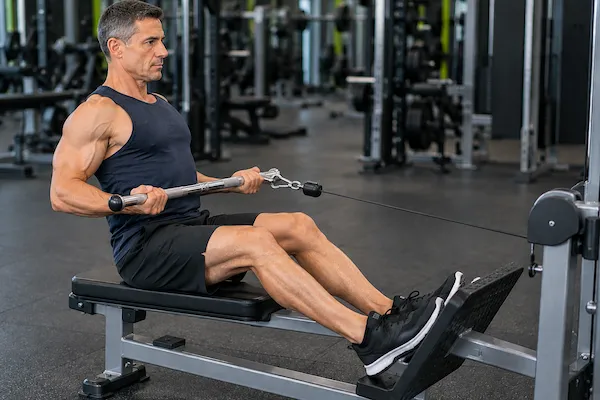
Man performing a seated cable row with a close neutral-grip handle, seated on a bench with feet supported on angled footplates.
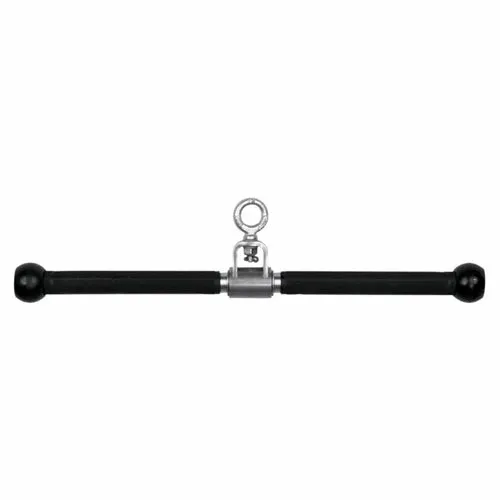
Straight cable attachment with two black gripping sections and a central metal connection eye.

Straight Bar — Overhand Grip

A straight cable bar with a central connection point. It allows an overhand grip with hand spacing adjusted along the bar.

Read more Show less about Straight Bar — Overhand Grip
Grip
Overhand — palms facing down.
Hand spacing
Approximately shoulder-width as a starting position. A wider grip requires a sufficiently long bar.
Arm action
Both arms pull together on one shared bar.

What Changes

The overhand grip changes forearm position and lets you vary hand spacing. The elbow path is the bigger influence on back-muscle demands: tucked elbows involve more shoulder extension and relative lat activity; elbows travelling farther out increase the relative contribution of the posterior deltoids and trapezius. In the seated-row study, biceps EMG was lower with pronated than with neutral or supinated grips.

Elbow & Pulling Path

With shoulder-width spacing, pull towards the upper abdomen with elbows near the torso. With wider spacing, allow the elbows to travel further out and pull towards the lower chest. Keep wrists straight and avoid forcing the bar against the body.

Setup & Compatibility

Use a bar designed for cable attachment and secure its central eye to the connector. Check that the bar clears the knees and station throughout the movement. Choose hand spacing that allows comfortable wrists and shoulders.

When to Choose

Choose it when you want an overhand grip or want to adjust hand spacing on one bar. Use a closer spacing for a tucked path or a wider spacing only if you can row comfortably with your elbows farther out.

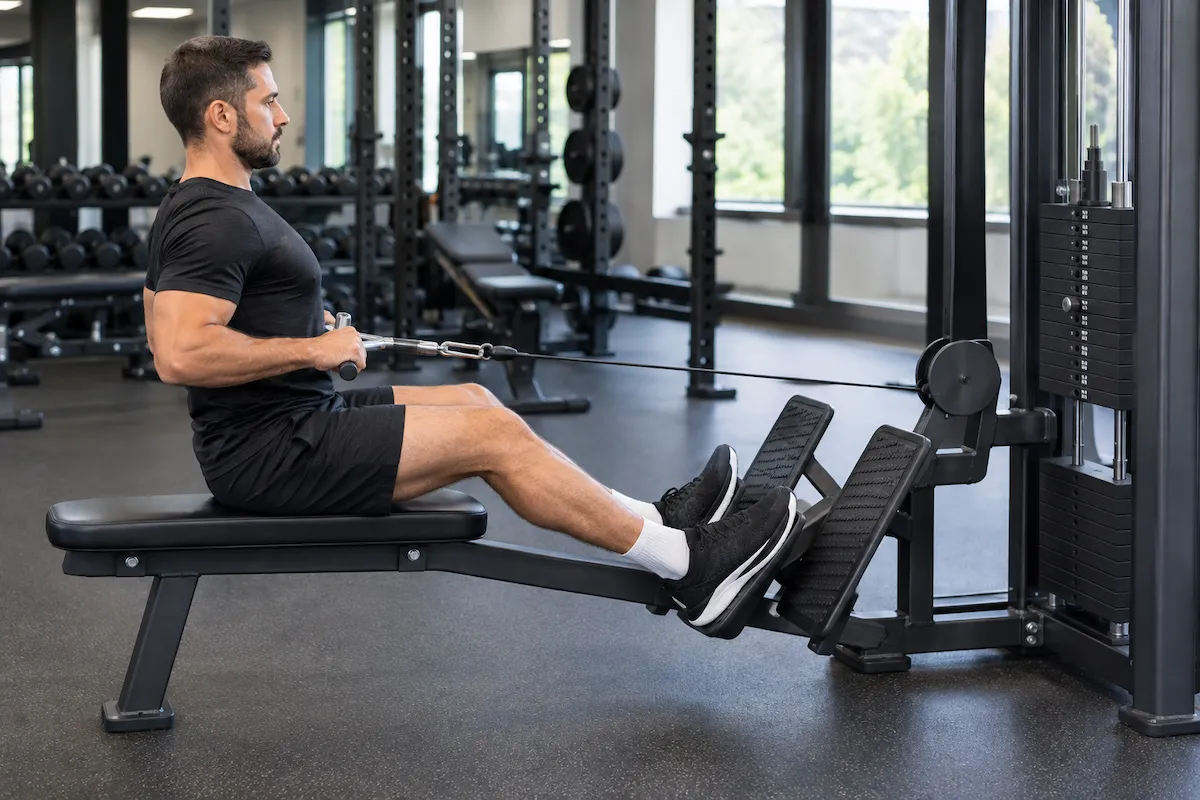
Man performing a seated cable row with an overhand straight-bar grip on a bench with supported feet.
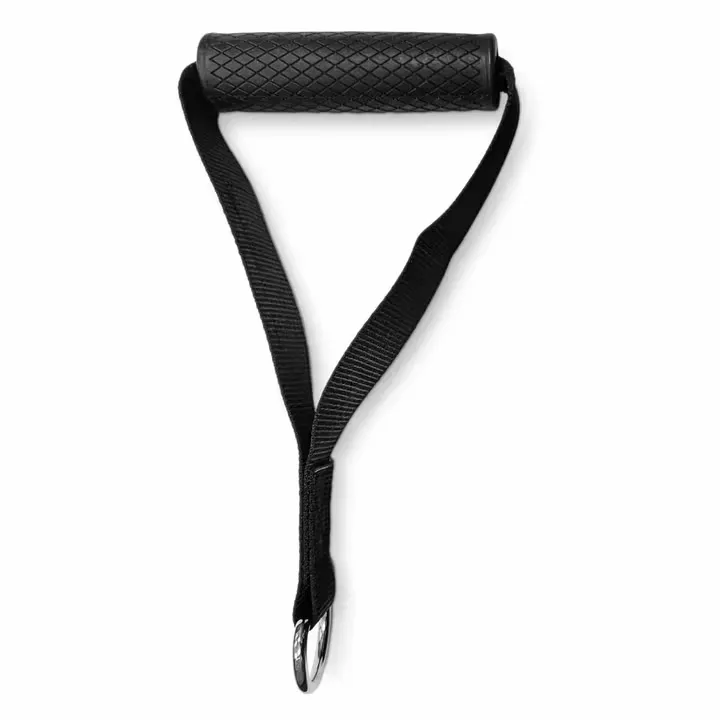
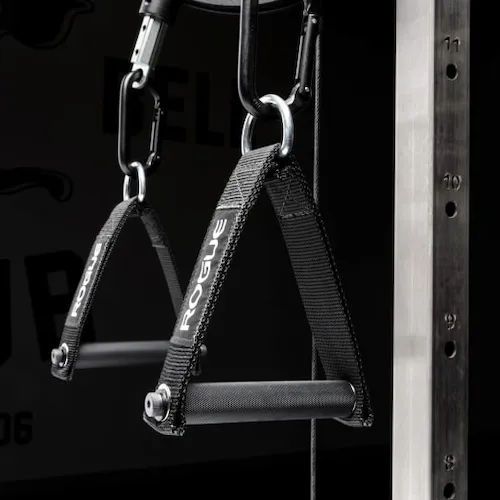
Single cable handle with a rotating grip, fabric strap and metal D-ring.

Single D/Stirrup Handle

A single-hand cable handle with a closed grip and a swivel connection. It can be attached to the low pulley for one-arm seated rows.

Read more Show less about Single D/Stirrup Handle
Grip
Usually neutral, with the palm facing inwards. The handle may allow forearm rotation, depending on its design; use a comfortable wrist and forearm position.
Hand spacing
One hand on the handle. The cable’s single connection point may limit how far across the body you can reach.
Arm action
One arm rows at a time. Use the free hand for support if the station provides a suitable place to hold.

What Changes

One handle lets you row one arm at a time and adjust that arm’s path independently. The handle may swivel, depending on its design. It does not automatically correct side-to-side differences.

Elbow & Pulling Path

Pull the handle towards the same-side waist with the elbow travelling near the torso, or towards the lower chest with the elbow travelling farther out. Keep the trunk steady and use a comfortable range.

Setup & Compatibility

Attach the handle securely to the low pulley. Sit on the dedicated bench with both feet supported. Check that the cable and handle clear the legs throughout the repetition. Use the available station support for the free hand without twisting the trunk.

When to Choose

Choose it to train one side at a time, set up a comfortable reach, or compare sides. Use the same range and controlled effort on each side; keep your trunk from rotating to finish the pull.

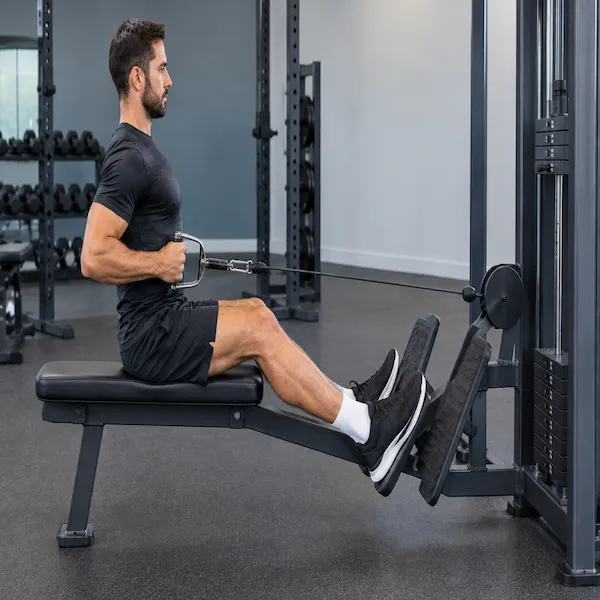
Single-arm seated cable row using a D-handle on a low cable pulley
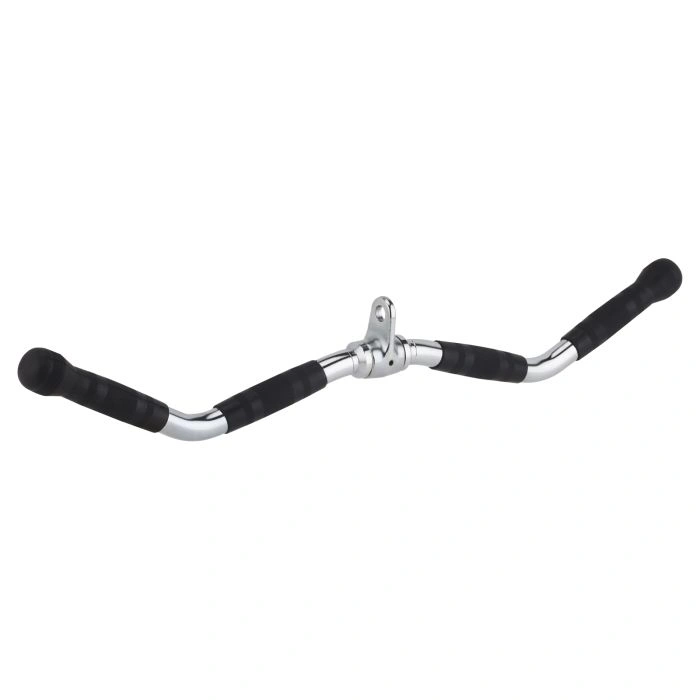
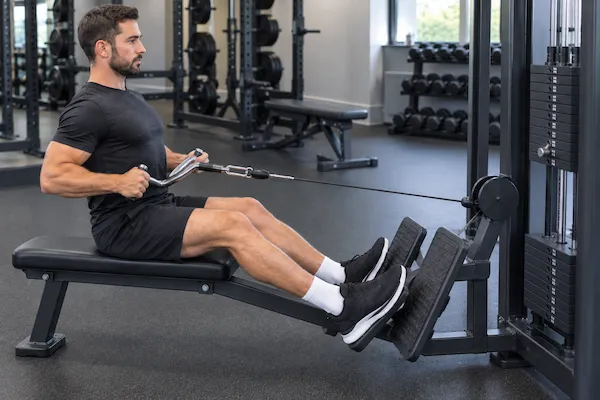
Angled EZ-style cable bar attachment for a seated cable row

Angled/EZ-Style Bar

Angled bar attachment with multiple grip sections, connected to the low cable by its centre.

Read more Show less about Angled/EZ-Style Bar
Grip
Angled or semi-supinated; hand position depends on the bar’s bends.
Hand spacing
Hold the matching angled sections, with hands placed symmetrically at a comfortable width.
Arm action
Both arms row together while holding the bar.

What Changes

The angled sections change hand and forearm position compared with a straight bar. They do not guarantee different back-muscle emphasis or reduced joint strain; that depends more on the elbow path and the individual’s comfort.

Elbow & Pulling Path

Pull the bar toward the torso with elbows following a comfortable path close to or moderately away from the sides.

Setup & Compatibility

Attach the bar’s centre connection to the seated-row cable and check the carabiner is secure.

When to Choose

Choose it when the angled hand positions let you keep your wrists comfortable and use a controlled row. Switch attachments if the bends force an uncomfortable wrist or elbow position.

Seated cable row performed with an angled EZ-style bar attachment
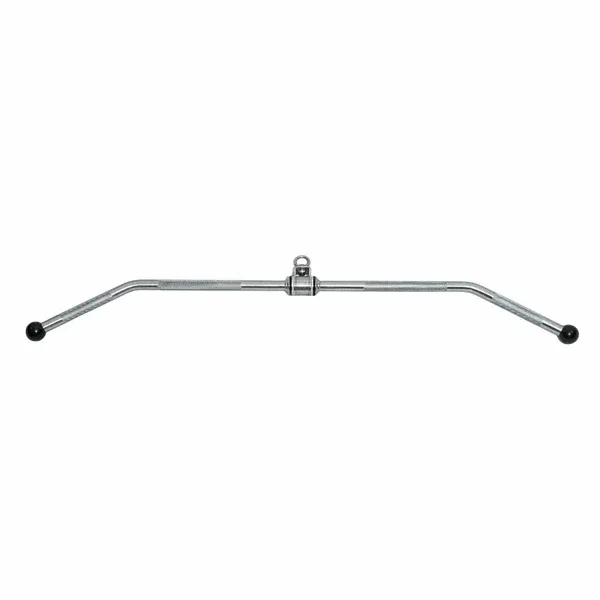
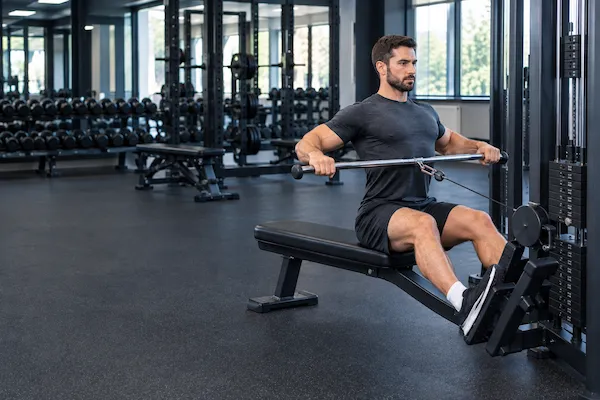
Wide cable bar attachment used for a seated cable row

Long Bar — Wide Overhand Grip.

A wide bar provides a wider hand position when the station allows a clear, comfortable row.

Read more Show less about Long Bar — Wide Overhand Grip.
Grip
Typically overhand with palms facing down; follow the bar’s available grip sections.
Hand spacing
Wider than the standard close-grip handle; choose a spacing that feels comfortable.
Arm action
Both arms row together while holding the bar.

What Changes

The wider bar allows a wider hand position, but the elbow path determines the main difference. With elbows travelling farther out, shoulder horizontal abduction increases. In the seated-row study, more abducted paths showed higher upper/middle trapezius and posterior-deltoid EMG, while closer paths showed higher lat EMG and peak force. These were acute EMG results, not proof of greater muscle growth.

Elbow & Pulling Path

Allow the elbows to travel out in line with the wider grip and pull toward the lower chest or upper abdomen. Use only the range that stays comfortable and clear of the station.
That describes the likely biomechanical difference without claiming that a wide grip isolates the upper back or produces superior activation.

Setup & Compatibility

Connect the bar securely to the low cable. Check that it clears the station and allows a controlled start and finish.

When to Choose

Choose it when you want to row with your elbows farther from your sides and place relatively more demand on the posterior deltoids and trapezius. Use the close neutral handle when you want a tucked-elbow, more lat-oriented path. Keep the wide position only if it feels comfortable and the bar clears the station.

Long Bar — Wide Overhand Seated Cable Row
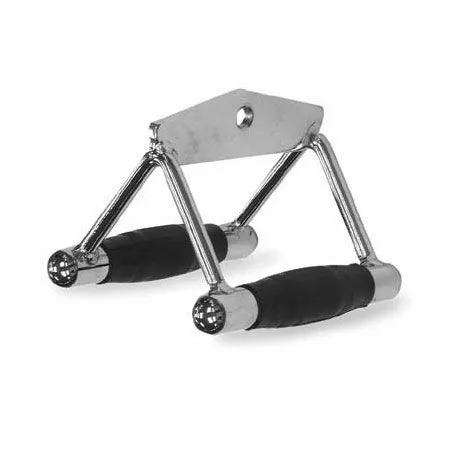
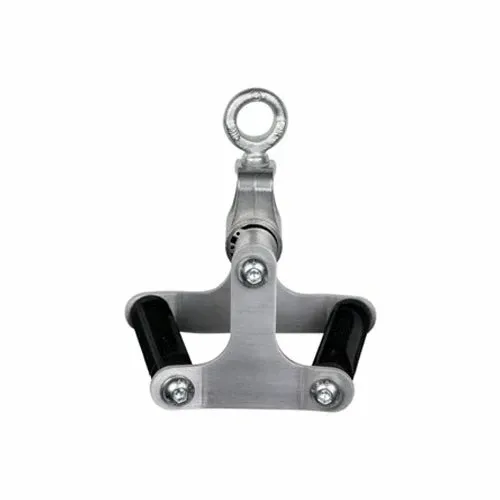
Medium Neutral-Grip Row Handle

Medium Neutral-Grip Row Handle.

Two parallel, fixed neutral-grip handles attached to a central mounting plate for two-arm cable rows.

Read more Show less about Medium Neutral-Grip Row Handle.
Grip
Neutral grip, palms facing each other.
Hand spacing
Fixed medium spacing. The handles do not move independently. Don’t assign a precise width from the photo.
Arm action
Both arms row together on the fixed handle.

What Changes

Compared with the close V-handle, this provides more space between the hands while retaining a neutral grip. The attachment permits a more open elbow path, but doesn’t force one. With elbows kept close, the movement remains a tucked row; as the elbows travel farther out, shoulder horizontal abduction increases and the relative contribution shifts toward the posterior deltoids and trapezius. The handle alone does not determine muscle emphasis.
Research on seated rows supports the role of elbow path: more abducted paths showed higher upper/middle trapezius and posterior-deltoid EMG, while closer paths showed higher lat EMG. The study did not test this exact attachment or establish differences in muscle growth.

Elbow & Pulling Path

Pull toward the midsection. The medium spacing allows the elbows to travel slightly farther from the torso than with a close V-handle, if that path is comfortable. Keep the trunk steady.

Setup & Compatibility

Attach the centre plate securely to the low cable and check that the connector closes fully. Test the handle’s fixed spacing and cable clearance with a light load before working sets.

When to Choose

Choose this when the close V-handle feels too cramped, but you still want a neutral grip rather than the wide overhand position. It offers a fixed, intermediate hand spacing for a more open row, if comfortable. If you keep the elbows tucked, expect more overlap with the close-handle version.

Athlete performing a seated cable row with one fixed parallel-grip attachment
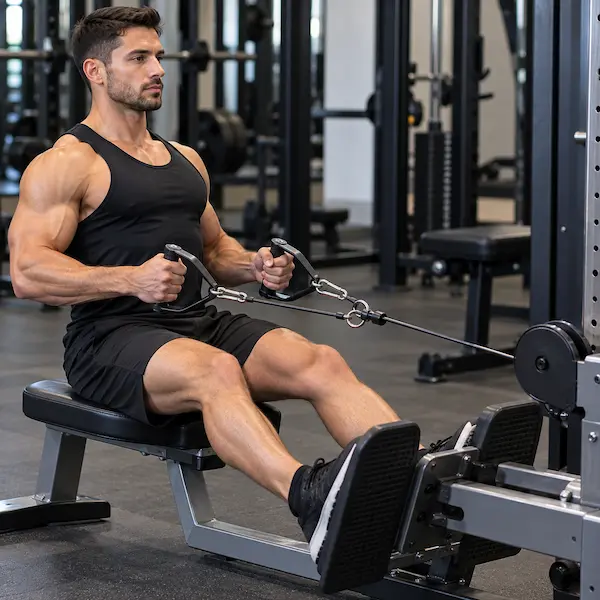
Two separate cable handles for a seated cable row

Paired Individual Handles

Two separate cable handles connected to the same low-pulley point, allowing each hand to move independently during the seated row.

Read more Show less about Paired Individual Handles
Grip
Usually neutral, with palms facing each other. The handles may rotate if the attachment design allows it.
Hand spacing
Self-selected; the hands can stay close or move slightly wider during the pull.
Arm action
Both arms row at the same time, but each hand follows its own path.

What Changes

Each hand can choose its own path instead of being locked to one bar or fixed two-handle plate. This may improve comfort and accommodate different shoulder widths, but it does not automatically create a different muscle emphasis. The main change comes from the elbow path: a closer, tucked path uses more shoulder extension and is associated with greater latissimus-dorsi activity, while a wider path increases shoulder horizontal abduction and tends to involve the posterior deltoid and upper-back muscles more. These findings come from seated-row research; the exact paired-handle attachment has not been tested directly.

Elbow & Pulling Path

Pull the elbows back toward the sides or slightly wider, depending on shoulder comfort. Keep both shoulders level and avoid twisting.

Setup & Compatibility

Attach two compatible handles to the same low-pulley connection. Check that both carabiners and handles are secure before sitting down.

When to Choose

Choose paired handles when the fixed bar or fixed parallel attachment feels restrictive, when the hands need different spacing, or when each shoulder needs a slightly different path. Use a fixed attachment when consistent hand spacing and identical arm travel are preferred. Do not choose paired handles expecting automatic correction of strength differences or guaranteed lat isolation.

Athlete performing a seated cable row using two separate D-handles connected to one low pulley.
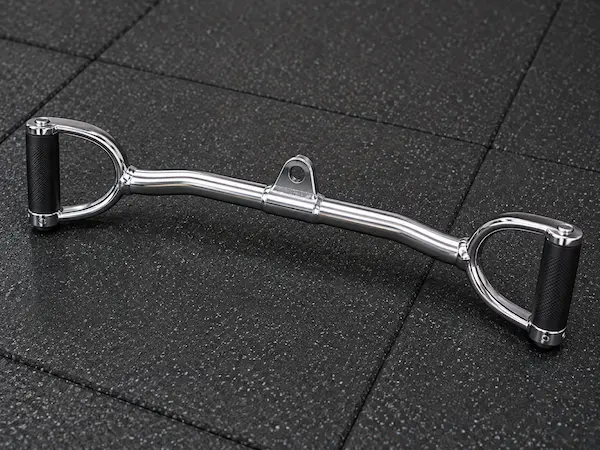
Medium-length chrome cable row attachment with two vertical neutral-grip handles at opposite ends and a central cable connection point.

Medium Neutral-Grip Bar — End Handles

A single rigid, medium-length cable bar with two handles positioned at opposite ends and a central attachment point. The fixed handles provide a neutral grip with more hand separation than a close-grip row handle.

Read more Show less about Medium Neutral-Grip Bar — End Handles
Grip
Neutral grip — palms facing each other, with wrists approximately straight.
Hand spacing
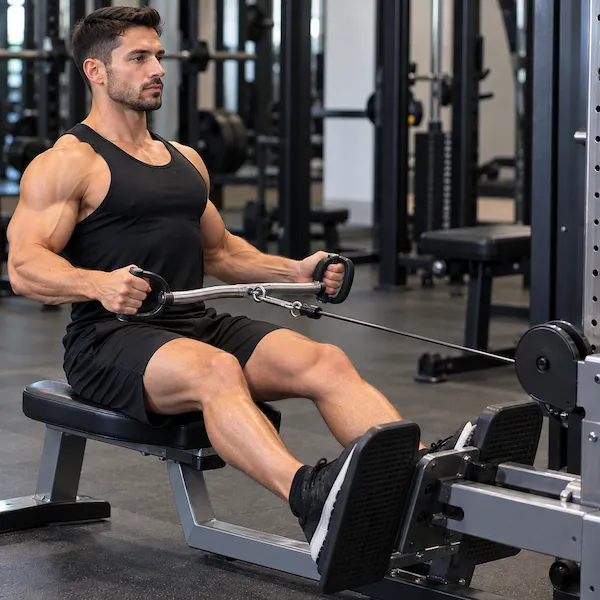
Fixed, approximately shoulder-width or slightly wider, depending on the attachment. Wider than a close neutral-grip handle but generally narrower than a dedicated wide-row bar.
Arm action
Bilateral horizontal pulling with shoulder extension, some horizontal abduction depending on elbow position, and elbow flexion. The shoulder blades move towards retraction during the pull.

What Changes

The medium bar provides a neutral grip with greater fixed hand separation than a close-grip handle. This accommodates a moderately wider elbow path while retaining the option to keep the elbows relatively tucked.
Compared with a wide bar, it offers a more moderate hand position. Unlike paired individual handles, both hands remain linked by one rigid attachment.
A more tucked elbow path generally favours shoulder extension and latissimus dorsi contribution, while greater shoulder abduction can increase posterior-deltoid and upper-back activity. These are movement-dependent differences, not guaranteed muscle-isolation effects.

Elbow & Pulling Path

Pull towards the upper abdomen or lower ribs, allowing the elbows to travel slightly away from the torso. Keep the wrists aligned with the forearms and avoid forcing the elbows excessively wide or pulling beyond a comfortable shoulder range.

Setup & Compatibility

Attach the bar’s central eye securely to a compatible low-pulley connector and check that the connector closes fully. Sit on the station’s bench with feet supported and knees slightly bent. Take both end handles with wrists aligned, then test the movement with light resistance. Check that the bar clears your knees and the station, and that sufficient cable travel remains throughout the intended range.

When to Choose

Choose this attachment when a close neutral-grip handle feels too narrow, but a wide-row attachment is unnecessary or uncomfortable.
It suits bilateral rowing with moderate, consistent hand spacing and a neutral wrist position. Use it when you want some flexibility in elbow positioning without the independently moving handles of a paired-handle setup.
Compared with a fixed parallel attachment, choose according to actual handle width and comfort; if their spacing is similar, there may be little practical difference.

Athlete performing a seated cable row using a medium-length bar with neutral-grip handles at both ends.
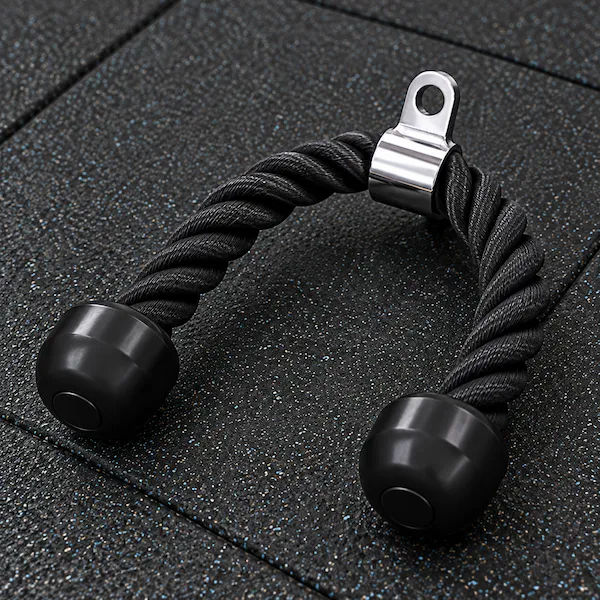
Black braided cable rope attachment with two rubber end stops and a central metal connection eyelet.

Rope Attachment — Flexible Neutral Grip

A double-ended braided cable rope with rubber end stops and a central metal connection. Unlike a rigid rowing bar, the rope allows the hands to move independently within the limits of its length and shared cable connection.

Read more Show less about Rope Attachment — Flexible Neutral Grip
Grip
Neutral or slightly angled grip, with palms generally facing each other. Forearm orientation can adjust naturally as the rope moves.
Hand spacing
Variable within the rope's length. Hands may begin relatively close together and separate during the pull, provided the rope is long enough and the movement remains controlled.
Arm action
Bilateral rowing with shoulder extension, elbow flexion and scapular retraction. Depending on how far the hands separate, the movement may include more shoulder horizontal abduction.

What Changes

Unlike fixed neutral-grip handles, the rope allows hand spacing and forearm orientation to change during the repetition. This provides more freedom to adjust the pulling path, although rope length may restrict the available range.
Compared with paired individual D-handles, the rope's two ends remain connected through one flexible attachment, so hand movement is not completely independent.
Muscle contribution depends primarily on shoulder and elbow movement rather than the rope itself. A tucked elbow path generally emphasises shoulder extension, while greater elbow separation increases the horizontal-abduction component.

Elbow & Pulling Path

Pull towards the lower ribs or upper abdomen, keeping the elbows relatively close initially. The hands may separate slightly as the elbows travel backwards. Avoid excessive elbow flare, wrist bending or leaning backwards to complete the repetition.

Setup & Compatibility

Secure the rope's central eyelet to a compatible low pulley. Check the rope, end stops and carabiner before use. Sit with feet supported, knees slightly bent and torso stable. Select a manageable load and confirm that the rope is long enough to achieve the intended pulling range without forcing the wrists or shoulders.

When to Choose

Choose the rope when you want adjustable hand spacing and a less constrained grip than a fixed neutral-grip bar.
It can suit controlled rowing variations where the hands separate slightly during the pull or where a rigid attachment feels restrictive.
Choose paired individual handles when more independent hand positioning is required, or a rigid handle when consistent spacing and a stable grip are preferred. The rope is an alternative for movement comfort and variation, not a proven superior muscle-building attachment.

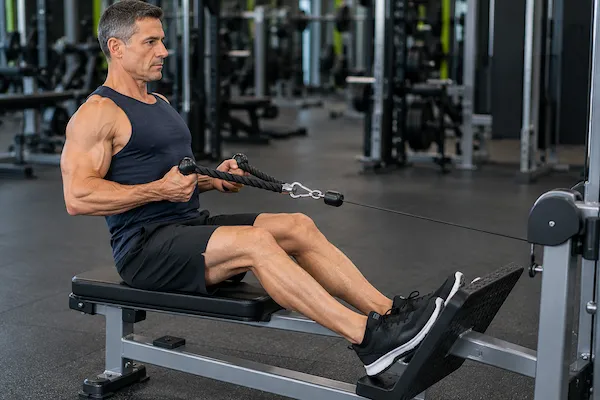
Man performing a seated cable row using a black rope attachment connected to a low pulley, with feet supported and torso upright.
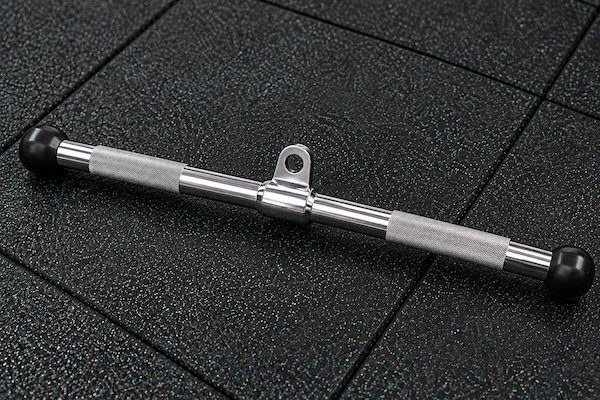
Straight chrome cable row bar with two knurled grip sections, black end caps and a central metal cable connection eyelet.

Straight Bar — Underhand Grip

A rigid straight cable bar with a central connection point, held with both palms facing upwards. This uses the same attachment as the straight-bar overhand row, but changes forearm orientation and may influence elbow positioning and comfort.

Read more Show less about Straight Bar — Underhand Grip
Grip
Supinated (underhand) grip, with palms facing upwards. Keep the wrists relatively straight and avoid forcing the forearms into an uncomfortable position.
Hand spacing
Approximately shoulder-width, adjusted for individual comfort and the available bar length. The hands remain at a fixed distance throughout the repetition.
Arm action
Bilateral rowing involving shoulder extension, elbow flexion and scapular retraction. The supinated grip places the elbow flexors, including the biceps brachii, in a mechanically different position from a pronated grip, although this does not establish greater muscle growth.

What Changes

Compared with the straight-bar overhand row, the underhand grip changes forearm orientation from pronation to supination. This alters wrist and elbow positioning and may make a relatively tucked elbow path more comfortable for some individuals.
Compared with a neutral-grip handle, the palms face upwards rather than towards each other. Both grips can support a tucked elbow path, but individual comfort may differ.
Unlike a rope or paired individual handles, the rigid bar fixes hand spacing and prevents independent hand movement.
Supination changes the mechanical contribution of the elbow flexors, particularly the biceps brachii, but does not automatically produce greater latissimus dorsi activation or superior hypertrophy.

Elbow & Pulling Path

Pull the bar towards the lower ribs or upper abdomen, allowing the elbows to travel backwards relatively close to the torso. Maintain a stable trunk, avoid excessive backward leaning and return the bar under control.

Setup & Compatibility

Attach a suitable straight bar securely to the low pulley using the machine's carabiner. Sit with feet supported, knees slightly bent and torso upright. Take an underhand grip approximately shoulder-width apart. Select a manageable load and ensure the wrists, elbows and shoulders feel comfortable before beginning.

When to Choose

Choose the underhand straight-bar row when a supinated grip feels comfortable and you want a bilateral rowing variation with fixed hand spacing.
It can provide useful grip variation alongside the overhand and neutral-grip options, particularly when exploring individual elbow and forearm positioning.
Prefer a neutral-grip handle if full supination feels restrictive at the wrists or elbows. Choose individual handles when independent hand positioning is more appropriate.
The underhand grip is a programming option rather than an inherently superior back-building exercise.

Athlete performing a seated cable row with a straight cable bar held in an underhand grip, elbows close to the body and feet supported on the footplate.
Coaching Essentials

Key Coaching Points & Common Errors

Focus on these key coaching cues and avoid the common technical errors that can reduce control, efficiency, and consistency.

01

Key Coaching Points

  • Keep both feet supported, knees slightly bent and torso steady.
  • Brace the trunk to resist the cable without excessive leaning or lower-back arching.
  • Guide the elbows backwards along the path chosen for your grip; keep them near the torso for the close neutral-grip version.
  • Allow the shoulder blades to move towards each other during the pull and forwards during the return.
  • Keep the wrists aligned with the forearms and maintain a secure grip.
  • Finish the pull within a comfortable shoulder range; the handle does not need to touch the body.
  • Control the return, allowing the elbows to straighten without rounding the lower back for extra reach.
  • Use a load that lets you repeat the same range and technique throughout the set.
02

Common Errors

  • Rocking the torso or leaning backwards to move a load you cannot control.
  • Rounding or excessively arching the lower back to extend the movement.
  • Shrugging to complete the pull or pinning the shoulder blades together throughout the repetition.
  • Changing the elbow path unintentionally as fatigue increases.
  • Forcing the elbows far behind the torso or pulling the handle against the body to create extra range.
  • Bending the wrists or forcing an uncomfortable hand position.
  • Rushing the return, dropping the weight stack or releasing the handle before the stack rests.
  • Shortening the range or losing trunk control because the resistance is too heavy.
Important Considerations
The technique shown uses a close neutral-grip handle. Other attachments change hand position and the elbow paths available; choose a combination that suits your shoulders, elbows and wrists rather than forcing every variation into the same path. A wider elbow path is a different rowing variation, not automatically a technical error.

The shoulder blades should move during the repetition. Keep the trunk controlled without holding the shoulder blades rigidly back or rounding the lower back to create extra reach. The appropriate finishing point depends on the attachment and your comfortable shoulder range.

Cable stations differ in pulley arrangement, cable travel and attachment clearance. Test the full intended range with light resistance, and compare progress using the same station, attachment and technique; stack numbers are not directly comparable across machines.

Increase resistance when you can complete the planned repetitions with consistent control and range. If a grip or range causes joint pain, reduce the load, adjust the range or change the attachment rather than forcing the movement.
Movement Science

Anatomy & Biomechanics

Understand the muscles, joints and movement mechanics involved in the exercise, including how the body creates force, maintains control and completes each repetition.

Anatomy
The seated cable row combines movement at the shoulders, elbows and shoulder blades. In the close neutral-grip version, the latissimus dorsi and teres major help move the upper arms backwards, while the elbow flexors bend the elbows. The middle trapezius and rhomboids contribute to shoulder-blade retraction, with the posterior deltoids assisting shoulder movement. The rotator cuff, trunk muscles and gripping muscles provide support and control. Their relative contributions change with elbow path, arm position and the amount of external support.
  • Latissimus dorsi and teres major contribute to shoulder extension as the upper arms move backwards from the reaching position.
  • The posterior deltoids assist shoulder extension and contribute more to horizontal abduction when the elbows travel farther from the torso.
  • The middle trapezius and rhomboids contribute to scapular retraction during the pull and help control the return towards protraction.
  • The trapezius and serratus anterior contribute to controlling shoulder-blade position against the rib cage; their roles vary with arm position.
  • Biceps brachii, brachialis and brachioradialis contribute to elbow flexion. Forearm orientation changes their mechanical contribution.
  • The rotator cuff helps stabilise the humeral head as the upper arm moves.
  • The abdominal wall and spinal extensors help maintain the unsupported trunk against the cable’s forward pull.
  • Forearm and hand muscles maintain the grip, while the wrist muscles help keep the hands aligned with the forearms.
Biomechanics
The seated cable row is an open-chain, multi-joint horizontal pulling exercise. Resistance acts along the cable towards the final pulley, allowing a predominantly forward-directed pull while the torso remains upright. Unlike a lever-arm rowing machine, the cable does not impose a fixed arc on the hands; the attachment, cable connection and individual joint movement shape the pulling path. The bench and foot supports provide a stable base, but without a chest pad the trunk must resist the cable’s forward pull. Shoulder and elbow loading change throughout the repetition because the cable angle and its perpendicular distance from each joint change, even when cable tension remains approximately steady.
  • Direction of resistance: The handle is pulled towards the final pulley. A low pulley usually creates a forward and downward force at the hands; the exact direction changes with pulley height, hand position and seated distance.
  • Difference from free-weight rows: A barbell or dumbbell is resisted vertically by gravity, so torso position strongly influences the pulling geometry. A cable provides a forward-directed resistance that permits rowing with a more upright torso.
  • Difference from lever-arm machines: The cable allows the hands to follow a self-selected path rather than a machine-defined arc. Attachment dimensions, cable travel and station clearance still constrain the available movement.
  • Difference from chest-supported rows: The bench supports the pelvis and the footplates provide a bracing surface, but the chest remains unsupported. Trunk muscles must resist forward movement; sitting does not remove spinal loading or the need for trunk control.
  • Close-elbow joint actions: With the elbows near the torso, the pull combines shoulder extension, elbow flexion and scapular retraction. During the return, the shoulders move towards flexion, the elbows extend and the shoulder blades move towards protraction.
  • Open-elbow joint actions: As the elbows travel farther from the torso, shoulder horizontal abduction becomes a larger component. The appropriate pulling height changes with this path, often moving from the upper abdomen towards the lower chest.
  • Muscle emphasis: Seated-row studies associate closer elbow paths with greater latissimus dorsi activity and more abducted paths with greater trapezius and posterior-deltoid activity. These findings describe acute muscle excitation rather than guaranteed differences in muscle growth.
  • Resistance profile: Cable tension does not produce constant joint torque. Shoulder and elbow demands depend on the perpendicular distance between each joint and the cable’s line of force, which changes throughout the repetition.
  • Start-position loading: When the arms and cable are nearly aligned, the external moment at the elbow can be small despite noticeable cable tension. A forward reach does not automatically mean maximum loading of the stretched muscles.
  • Pulley and seating geometry: Pulley height, seated distance and attachment length change the cable angle, starting reach and available travel. These differences can alter joint loading even when the same stack setting is selected.
  • Scapular movement: Shoulder-blade protraction and retraction contribute to handle travel alongside shoulder and elbow movement. Holding the shoulder blades fixed changes how the movement is distributed between these structures.
  • Grip and attachment effects: Fixed bars link the hands and constrain their spacing and orientation. Individual handles permit more independent positioning, while ropes allow movement within their length and shared connection. Grip choice influences comfort and elbow-flexor mechanics without isolating a particular back muscle.
  • Bilateral and unilateral loading: Two hands on one attachment share the same resistance source, so equal hand movement does not prove equal force production. Single-arm rowing adds an asymmetric pull that the trunk must resist if rotation is restricted.
  • Trunk movement: Leaning or extending through the hips changes the shoulder-to-cable relationship and adds movement beyond the arms and shoulder blades. A controlled hip-hinge variation should be distinguished from the steady-torso version described here.
  • Contraction phases: The shoulder extensors, elbow flexors and scapular retractors generally shorten during the pull and control the return while lengthening. The trunk and wrist muscles work mainly to stabilise their positions in the steady-torso version.
  • Range of motion: Useful range depends on shoulder movement, scapular control, attachment clearance and cable travel. Touching the handle to the body or pulling the elbows farther backwards does not necessarily add useful shoulder range.
  • Machine loading: Pulley ratios, friction and stack acceleration affect the resistance transmitted to the handle. Stack labels are not directly comparable across different cable stations.
Practical Application

Variations & Programming

Explore useful exercise variations and learn how the movement can be selected, adapted and programmed according to your training goal, experience and individual needs.

Variations
  • Close Neutral-Grip Seated Cable Row
  • Medium Neutral-Grip Seated Cable Row
  • Overhand Seated Cable Row
  • Wide Overhand Seated Cable Row
  • Underhand Seated Cable Row
  • Single-Arm Seated Cable Row
  • Seated Cable Row with Paired Individual Handles
  • Rope Seated Cable Row
Programming
  • Horizontal pulling strength development.
  • Back hypertrophy and supplementary elbow-flexor training.
  • Additional pulling volume within upper-body or full-body programmes.
  • Practising coordinated shoulder, elbow and shoulder-blade movement with a controlled trunk.
  • Adjusting grip and elbow path to suit individual comfort and training priorities.
  • Single-arm training when independent side-by-side practice is appropriate.
  • Seated pulling when a sustained bent-over position is unsuitable or limits performance.
Typical Rep Range 8–15 repetitions
Programming Note
Select the attachment, elbow path and range according to the training goal and individual comfort. The close neutral-grip version provides a repeatable starting option; other attachments are alternatives rather than necessary additions to every programme. Changing the grip alone does not guarantee a different back-muscle emphasis.

The exercise can serve as the main horizontal pull or as supplementary work alongside other pulling exercises. Place it earlier in the session when improving cable-row performance is a priority, or later when it provides additional back-training volume. Consider the combined demands of other rows, pulldowns and elbow-flexion exercises when setting the workload.

Choose resistance that allows the planned repetitions with consistent range and trunk control. Increase repetitions within the prescribed range, then increase the load by the smallest suitable increment once the target is achieved at the intended effort. Avoid counting additional rocking or a shorter pulling range as progress.

Keep the station, attachment, seated position and technique consistent when tracking performance. Different pulley systems and stack labels are not directly comparable. Record single-arm repetitions and loading per side; paired handles connected to one cable do not provide independently adjustable resistance.

Sets, rest periods, training frequency and proximity to failure should be prescribed in the individual workout. Reaching muscular failure is not compulsory; finish the set when the prescribed effort is reached or when another repetition would require a substantial change in technique.
Workout Application

Training Considerations

Use these guidelines to adapt the exercise to individual needs, experience and tolerance.

Use Caution When
  • Shoulder, elbow or wrist symptoms that increase with the chosen grip, elbow path or pulling range.
  • Lower-back symptoms aggravated by unsupported sitting, forward reaching or resisting the cable’s pull.
  • Loads that pull you out of position or require rocking, excessive backward leaning or jerking.
  • Starting positions that require an uncontrolled reach to collect or return the handle.
  • Attachments that contact the knees or station, restrict comfortable joint movement or exceed the available cable travel.
  • Single-arm rowing when the resistance causes uncontrolled trunk rotation or loss of balance.
  • Difficulty maintaining secure foot contact or a reliable grip throughout the set.
Possible Modifications
  • Reduce the resistance and practise controlled repetitions before increasing the load.
  • Shorten the starting reach or finishing range to stay within comfortable, controlled shoulder movement.
  • Change the attachment or hand spacing if the current grip forces an uncomfortable wrist, elbow or shoulder position.
  • Adjust the seated position within the station’s intended setup to improve reach, foot support and attachment clearance.
  • Use a chest-supported row when maintaining the unsupported trunk position is uncomfortable or limits the exercise.
  • Use two-arm rowing with a manageable load if single-arm rowing causes unwanted trunk rotation.
  • Use individual handles when they allow a more comfortable hand and arm position, provided the connections are compatible with the station.
Safety Note
Before starting, check the visible cable, attachment and connector for damage, confirm that the connector closes fully, and fully insert the correct selector pin. Do not use equipment with frayed cables, damaged attachments or a connector that will not close; report the problem to gym staff. Change the load or attachment only when the weight stack is fully resting, and keep hands, clothing and hair clear of moving parts.

Test the intended range with light resistance. Establish secure foot support and a controlled seated position before pulling. Keep hold of the attachment and guide the stack gently to rest before releasing it or leaving the bench. Do not attempt to free a jammed stack yourself.

Stop the exercise if it produces sharp or increasing pain, numbness, tingling or sudden loss of strength. Persistent or recurring symptoms require individual assessment before progressing. Follow the instructions for the specific station and any relevant rehabilitation restrictions.